PROJECT EXAMPLES
Invent a mousetrap: Show the energy stored in a compressed spring, the force the trigger exerts on the spring to keep it from uncompressing, and predict the path of the hammer when it is released to hit a mouse in the target zone. In a second diagram, show the final state, noting the reduced energy in the spring and the force holding the hammer down. Write, as a poem or in prose, the “story” of force, energy, and the poor mouse that got clobbered with the predicted number of Newtons of force. This is a great story of invention. Inventions can be fanciful or practical. Have fun!
Pictures illustrating forces -- Leonardo's Water Lifting Device and a student's Wing Design 'A Push Up'
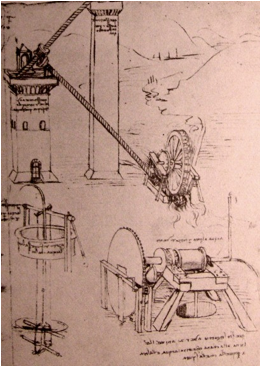
Drawing of water lifting device
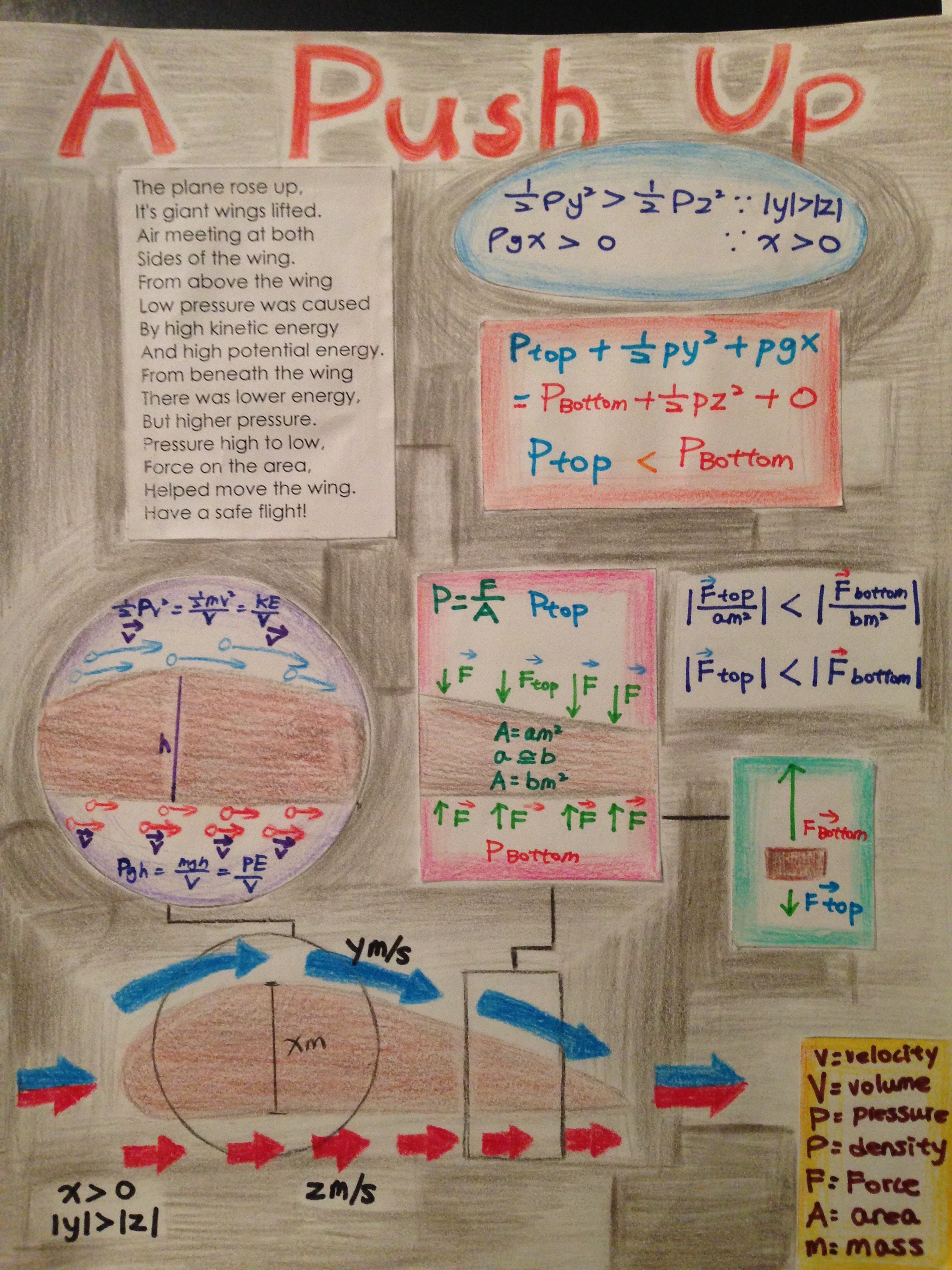
"A Push Up" - illustration of forces on a wing
"Leonardo's and the student sample arranged thoughts in visual form and illustrate connections between physical form and natural forces. Both these examples are missing an important aspect of engineering: Giving magnitudes to the object and to the forces acting on the object that can lead to generalized formulas and graphs!
For Leodardo's turning water wheels the amount of water flow might be expressed in "Liters per second" . The speed the wheel turns in "radians per second" or in English units, "revolutions per second" (There are 2x Pi radians in one 360 degree revolution, so knowing that one can "convert" from one "unit of measure" to another if need be!) How much "work" can one get from the wheel? It is measured by multiplying the rotation rate and the torque...and do you see how more helpful his sketch would be if he had added some dimensions of size (units: Meters), and let us know an "estimate" of how much work he thought the design would produce?
For the next sketch basic laws of physics are illustrated and shown how that will result in a "lifting force" on the wing design. Again some "estimated" magnitudes associated with the units would help communicate how just a small pressure difference from the high pressure underside of the wing and the low pressure above can lift the heavy weight of a plane. The force is "calculated" by multiplying that "pressure difference" by the large "area" of the wing! Just one pound per square inch of difference acting on just 1 square foot equals an upward force of 144 pounds! (12x12 inches = area 1 psi acting on that area = 144 pounds)
In YOUR sketches and poster keep these ideas in mind. Label (give names) to the parts of your invention. Sometimes sketching just a very simple invention might make it easier to incorporate all the engineering ideas of your invention!
Copyright 2014 Hawaii CyberSpace Hosting services provided by Stanton Web Applications