A STEAM Opportunity: “The Inventive Engineer” Poster Contest!
The January issue of the monthly newsletter of HSFCA has as its last article an invitation to participate in the Inventive Engineer Contest. The text appears below here, but the full color version in newsletter format may be found at: InventiveEngineer_HSFCA-Enews-January2014.pdf
Science, Technology, Engineering, Art and Math are separate disciplines collectively known as STEAM. The “process of thinking” demanded by the engineer profession is built on creative blending of the skills defined by STEAM. There is an easy way to introduce middle and high school students to a STEAM based lesson satisfying Common Core State Standards!
As part of a celebration of National Engineers Week in mid-February, The Hawai'i Council of Engineering Societies is inviting middle and high school students to use a full range of STEAM skills to create and submit a poster by 7 February. The poster will be judged on effective use of well-defined engineer terms and standard units of measure in an appealing creative format. The poster communicates a Student’s own or an existing invention, mechanism, or engineered design.
The contest is open to public, private, and home school students across the state. It is designed to be uncomplicated to enter. Students are encouraged to use internet and software tools and grow ideas for their poster in free communication with other students and with teachers and parents. Application instructions, rules, and helpful tutorial information are at: www.HawaiiCyberSpace.com/EngineersWeek.
Teachers, parents, and students may also address specific questions, and announce their intention to participate, in an email to: Mentor@alum.MIT.edu
The Posters of up to 12” x 18” will be on public display at Pearlridge Shopping Center. Cash and prizes will be awarded! “Engineering combines art and science and math and technology: be artistic!” said contest coordinator Philip Blackman. The Inventive Engineer Poster Contest is amplifying this year's Engineers Week theme: "Bringing Dreams to Life"
When Congress passed the America COMPETES Act in 2007, also known as the STEM Act, it authorized funding for science, technology, engineering and math education. In 2012, Congresswoman Suzanne Bonamici (D-OR) and Congressman Aaron Schock (R-IL) urged the inclusion of the Arts as well. Many advocate that integrating art and design with the other technical fields of STEM will best nurture a creative future workforce. During the summer of 2013 and supported in part by Hawaii State Foundation on Culture and the Arts (HSFCA), both the Hawai‘i Arts Alliance and the Maui Arts & Cultural Center held summer institutes for classroom teachers that highlighted the connections between STEM and the arts labeled STEAM!
The new Common Core State Standards in English Language Arts, for example, anchor standard 5, ask students to “make strategic use of digital media and visual displays of data to express information and enhance understanding of presentations.” Through the Inventive Engineer Posters, ideas will be expressed non-verbally and visually. Sketches, drafted details, labels, narrative description of parts and function, symbols, formulas, and correctly used standard units of measures with magnitudes will Bring Dreams to Life with an exciting rigor and artistry to generate interest and persuasive understanding.
|
|
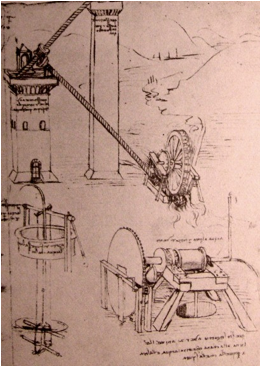
" From the days of the 1400's in Leonard da Vinci's time to now, the ability to make precise measurements, interpret nature's conduct in mathematical formulas, use computer tools and internet resources has altered significantly the possibilities! Even young students can express significant inventiveness and special artistic clarity in presentations surpassing that of Leonardo!"
Examples of Engineers’ Language:
“Energy” is measured in “units” of “force” x “length” of travel: The “formula” is E = F x L Standard Metric units of measure are: E = “Joule” F = “Newton” L = “Meter” Energy may be stored or converted into different forms: “heat”, “work”, “potential”, “kinetic”, “chemical”, etc., but can be always measured in “Joules”!
”Motion” is described as a change in location during an interval of “time”. It has “direction” as well as “magnitude”. All units that have direction and magnitude are called “vectors”. Force, velocity, and acceleration are vectors.
A “Magnitude” associated with a “unit” answers the question: “How much”. “Parts” are given names describing shape or function. “Narratives” explain the how and why. “Specifications” describe quality, capability, and limits.
|
Copyright 2014 Hawaii CyberSpace Hosting services provided by Stanton Web Applications